
Black Weather Report
On Sentiment, Circulation, and Allensworth’s Newspaper

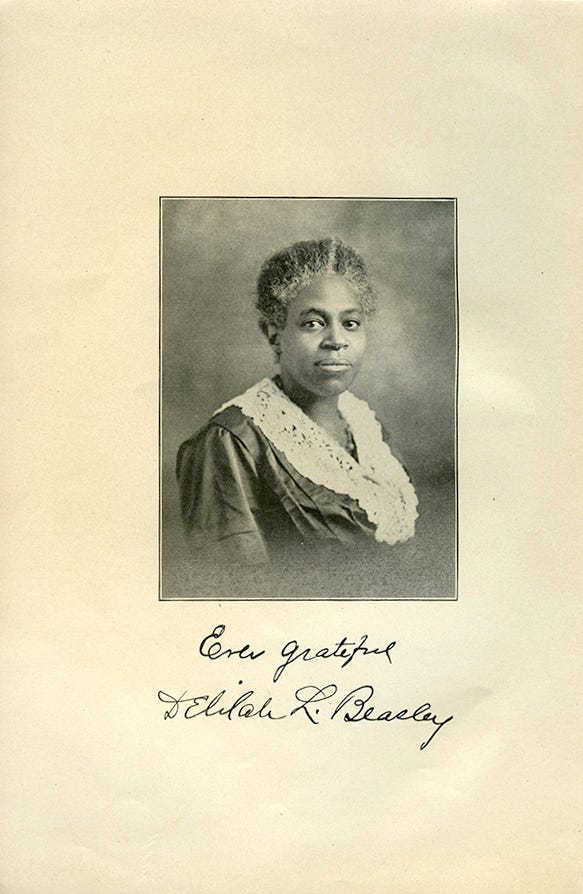
“The greatest literary work done by the Negro is through his weekly papers.” — Delilah L. Beasley, The Negro Trailblazers of California (1919)
“Their deeds may not have been published in newspapers, nor their names embalmed in libraries. Fame has refused to herald them abroad, obscure and unknown they have acted their part in the drama of life and have passed on; but if we mistake not, a record of their deeds will be found in the book of life.” — Col. Allen Allensworth, quoted in Out of Darkness: The Story of Allen Allensworth by Evelyn Radcliffe (1995)
The phrase “sentiment making” appears frequently in my uncle Allen Allensworth’s early writing about the Black colony he founded in 1908. Allensworth’s founding vision drew on both the practical model of Booker T. Washington’s Tuskegee Institute and the broader philosophy of racial uplift it embodied: the idea that Black advancement would come through economic self-sufficiency, vocational training, and careful cultivation of public perception. Allensworth’s pioneering families sought to build what they called a “Tuskegee of the West.”
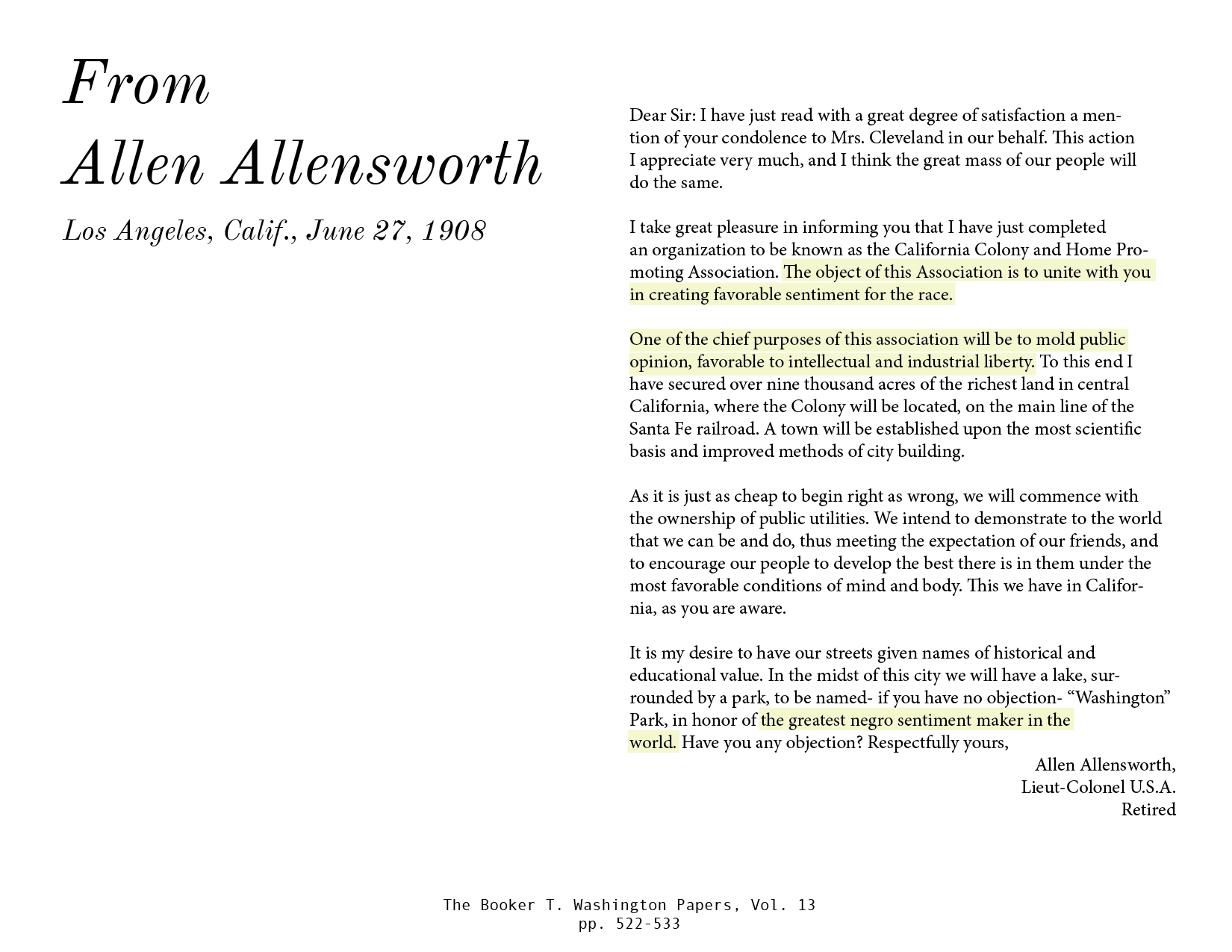
In a 1908 letter to Washington, Allensworth describes the town’s aim as “to unite with you in creating a favorable sentiment for the race” and “to mold public opinion, favorable to intellectual and industrial liberty.” What he called “sentiment making” was, from the outset, a conscious strategy. For Allensworth, narrative building was inseparable from place-making. Part of the work of building the colony was also to broadcast a story about it, to work on the political weather that would determine whether it could survive and grow.
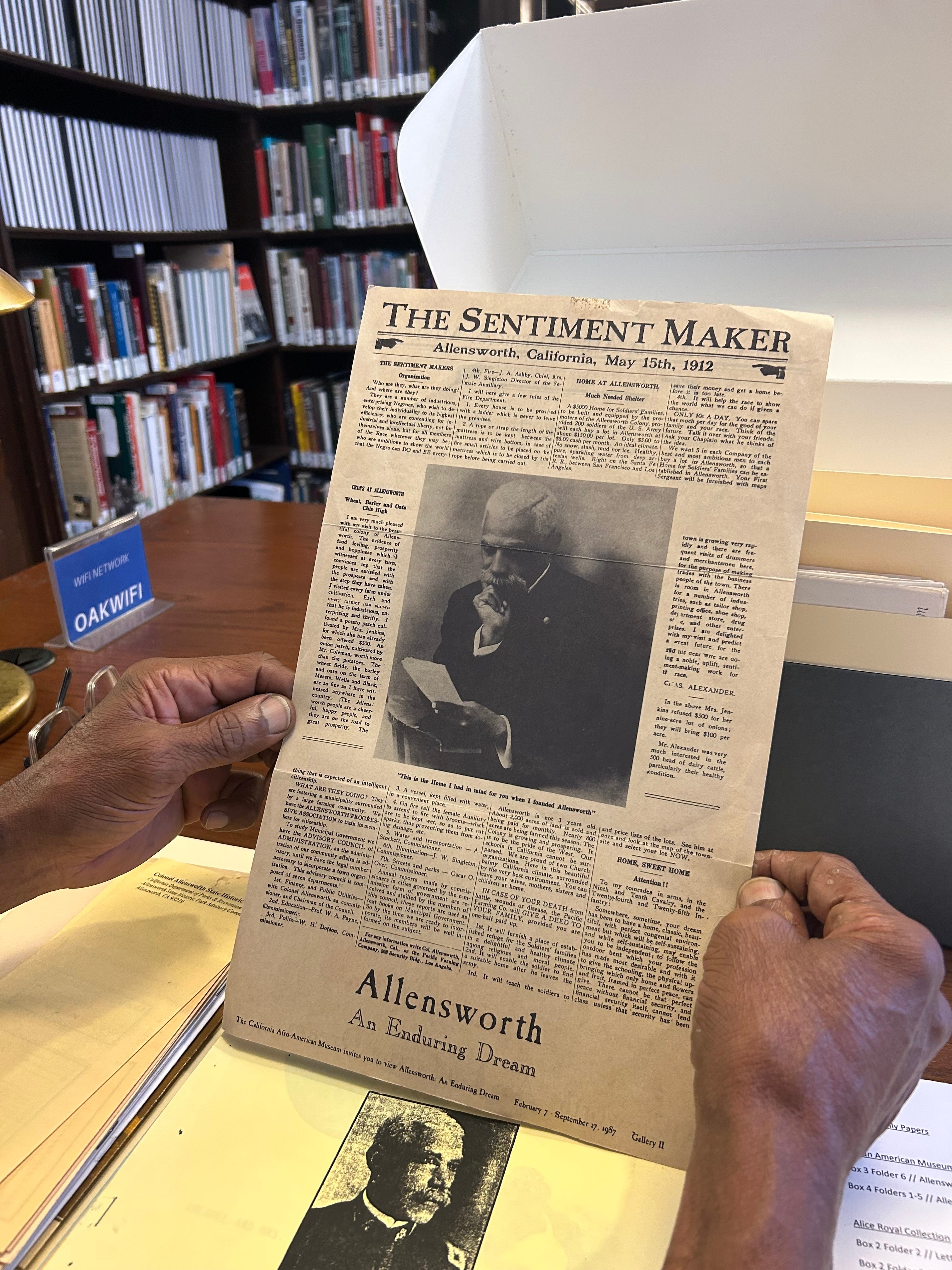
It is no coincidence, then, that the township’s newspaper came to be called The Sentiment Maker. I have only been able to locate a single surviving issue from 1912. Whether or not others were produced, this fragment offers a portal into the early life of the colony and how its residents wanted that life to be understood.
The Sentiment Maker was, in this sense, the instrument of the project its name described: a tool for narrating a life Allensworth’s early settlers, most of whom had been born into slavery, had been told they would never be allowed to live, and circulating that narrative as evidence of what Black self-determination could look like.
It places Allensworth’s paper within a longer tradition of Black publications functioning as what Neta Bomani and Mariame Kaba recently called “movement tools, not just media,” outlets whose purpose was never just to inform but to organize, agitate, and materially advance the conditions of Black life.
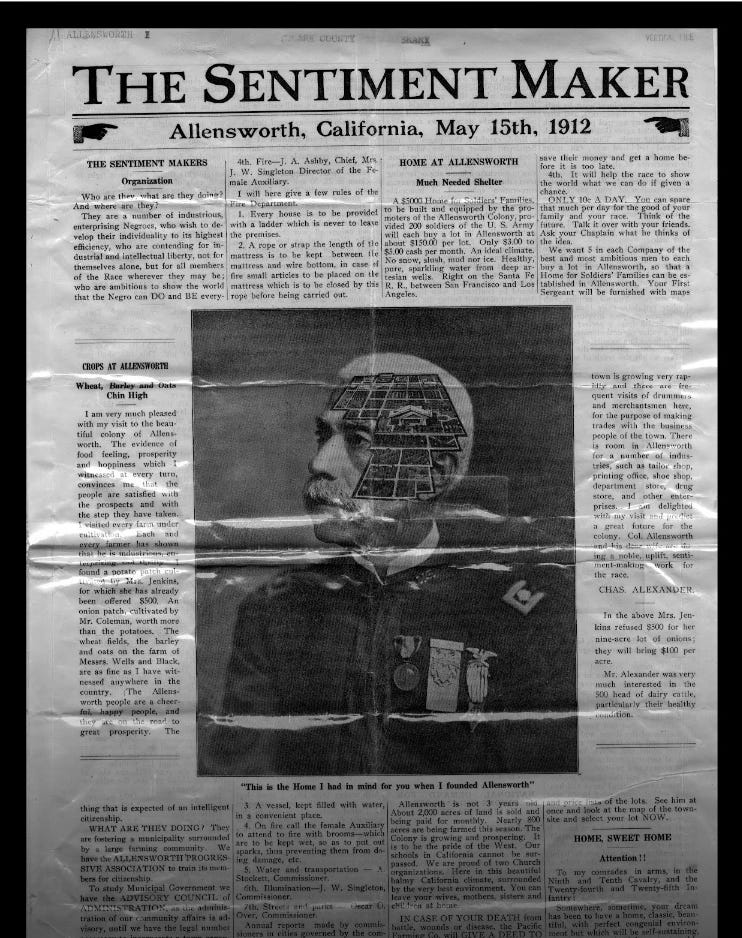
The 1912 issue simultaneously reads as a progress report, recruitment tool, civic primer, and philosophical manifesto. The front page opens with a definition of sentiment makers, describing them as “industrious, enterprising Negroes… contending for industrial and intellectual liberty, not for themselves alone, but for all members of the Race wherever they may be.” The definition frames them as ambitious to show the world what Black life could be in the decades following Reconstruction.
What follows are agricultural dispatches reporting on bumper crops of wheat, barley, and oats. Real estate notices invite Black soldiers westward with an explicit appeal to military solidarity: “You will not be living among strangers but in the midst of fellow comrades with whom you have soldiered.” A section on municipal governance reports that annual government documents “are used as text books” so that “by the time we are ready to incorporate, its members will be well informed on the subject.” The Women’s Progressive Improvement Club takes up an entire column, documenting women’s civic organizing as central to the colony’s self-governance project. The Sentiment Maker was not just narrating a community. It was helping to produce one.
In her 1919 book The Negro Trailblazers of California, Delilah L. Beasley chronicles the ways Black papers were central to a broader narrative ecosystem through which ideas, values, and forms of collective life were circulated. At a time when white newspapers often reduced Black life to criminality or caricature, Black papers worked to change the political weather. I draw this framing from community organizing and from Christina Sharpe, who theorizes “the Weather” as the afterlife of slavery made atmospheric: anti-Blackness as total climate, as the environment Black communities move through and continually remake into new ecologies. Black papers offered a different register, circulating visions of Black life that exceeded the limits imposed by the dominant record. They played an important role in the Black Towns Movement, not only recording these communities as they emerged across the United States in the decades following Reconstruction, but helping to sustain, circulate, and imagine them into being. In Black papers like The Liberator, the New York Age, the Washington Bee, and the California Eagle, Allensworth was continually made visible, celebrated, and brought into relation with other all-Black towns. Archivist and author Arianne Edmonds documents this directly in We Now Belong to Ourselves: “Domestically, all-Black towns like Mound Bayou in Mississippi and Allensworth in California received continual praise and support from The Liberator. Jefferson would often give updates on their self-governing approaches.”1
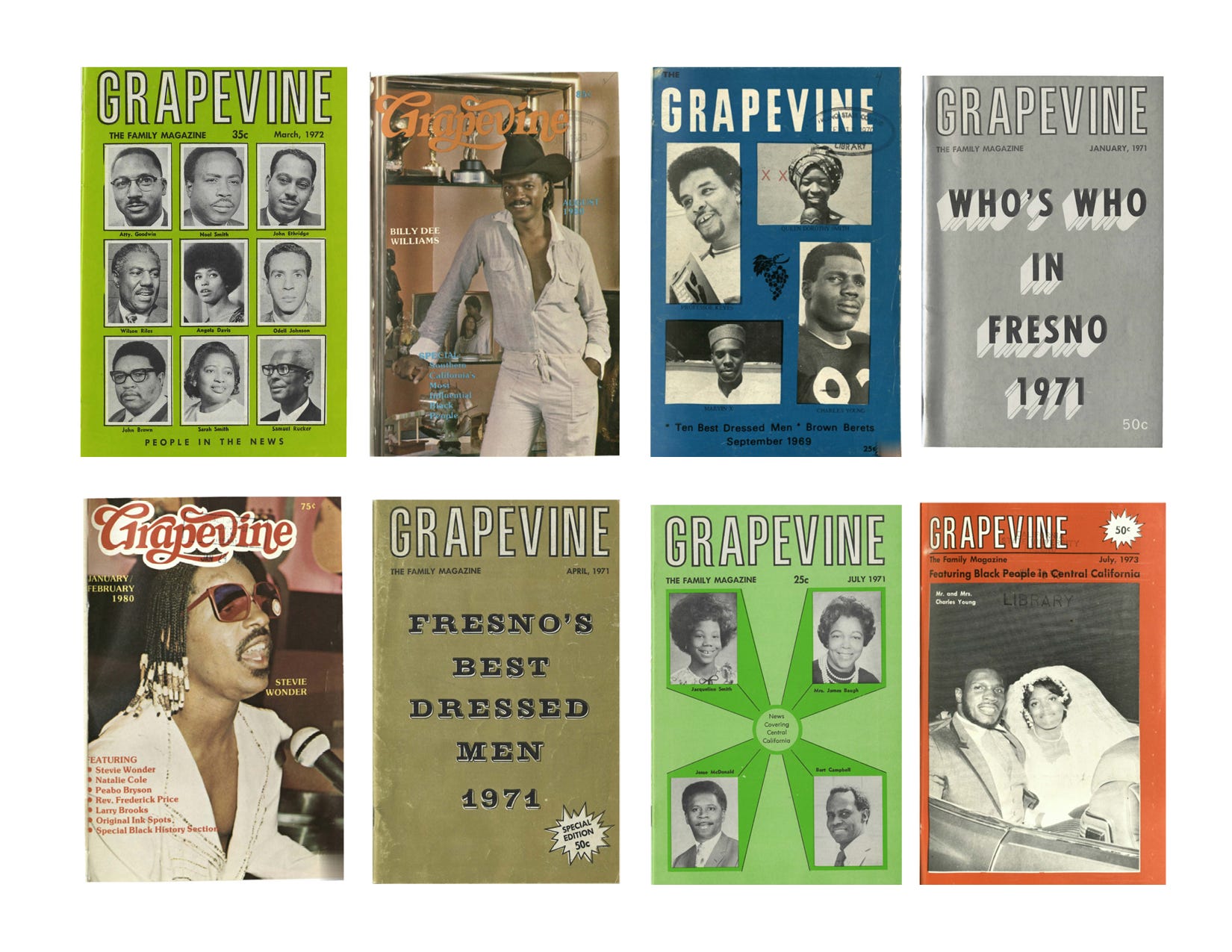
Black publications have long functioned as instruments of place-making and spatial reclamation, tools for asserting presence, documenting belonging, and representing Black communities’ relationships to the places they built and called home. Just fifty miles north of Allensworth, Grapevine Magazine emerged in Fresno in 1969, founded by six young people who saw a need for a publication that would document and celebrate Black life in the Central Valley and built something to fill it. Its name weaves together regional specificity and Black culture in a way that feels potent. It’s possibly borrowed from the colloquial name for the roughly 40-mile stretch of Interstate 5 connecting Los Angeles to the San Joaquin Valley floor. Or the grape industry that has long shaped the Central Valley’s agricultural landscape and labor history. Or “I Heard It Through The Grapevine,” the song made famous by Gladys Knight & The Pips and Marvin Gaye in the 1960s, a meditation on how news travels through community networks (for better and worse). Or perhaps all three. Either way, the name performs the magazine’s project: inscribing Black life into the California landscape. For over two decades it documented what the white-owned press never thought to record: local businesses, weddings, community milestones, the texture of everyday Black life in the valley.
In Tulsa, The Oklahoma Eagle provides another example of sentiment making at work. Founded in 1922 as a successor to the Tulsa Star, which burned in the 1921 Tulsa race massacre, The Eagle emerged in the shadow of a catastrophe partly ignited by a white newspaper's sensationalized and likely fabricated account of an encounter between a Black man and a white woman. It reported on the massacre at a time when those same white-owned newspapers in Tulsa refused to acknowledge it. That act of witness is itself a form of sentiment making, the Eagle functioning as a counter-narrative at the precise moment the dominant press was either stoking the violence or erasing it. The paper has continued to publish weekly for over eight decades. Perhaps what kept it going was its rootedness: a family’s commitment to a specific place and the people who call it home. When Jim Goodwin asked his father why they held on, Ed Goodwin Sr. gave him a simple answer: “Always keep this newspaper. It will be a source of influence.”2
Understanding Allensworth’s investment in “sentiment making,” though, requires sitting with the ideological framework it operated within. Booker T. Washington’s philosophy of racial uplift was the dominant framework for Black advancement at the time Allensworth was founded. At the same time, looking back with the privilege of hindsight, its limits are visible. What Evelyn Brooks Higginbotham later named the “politics of respectability” clarifies the double bind at work: if shaping perception could operate as a strategy of survival, it also risked locating the problem in Black behavior rather than in the conditions that made such strategies necessary in the first place.
By 1903, W.E.B. Du Bois had already mounted a critique of Washington’s conciliatory stance, arguing that his emphasis on economic participation, coupled with a strategic accommodation of segregation and limited public challenge to disenfranchisement, risked legitimizing the erosion of civil and political rights.3 Washington maintained widespread influence over the Black press, effectively consolidating what counted as “acceptable” racial politics. By 1910, Du Bois founded and became the editor of the NAACP’s publication The Crisis as a direct counter to the accommodationist press, including the New York Age, a paper Washington partially owned and used to shape his public image. As Washington’s influence over Black public discourse was increasingly contested, The Crisis became one of the most widely read Black publications in the country, representing a different vision of what Black print culture could do: not simply manage perception, but reorient it around claims to citizenship and rights.
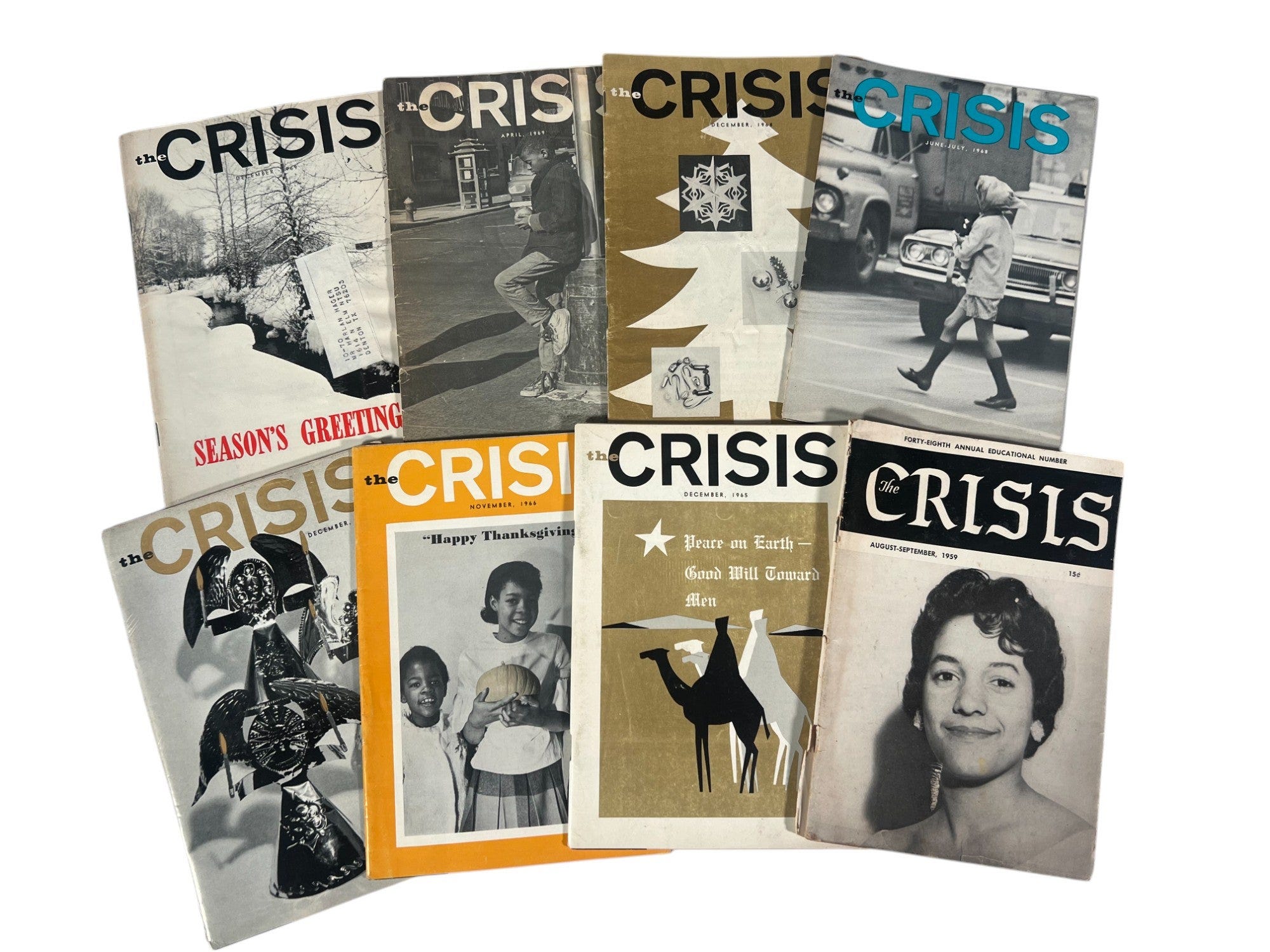
Read against this backdrop, Allensworth’s investment in sentiment making can be understood as a strategy shaped by the dominant ideology of its moment, with all the possibilities and limits that entailed.
Reading the paper now, there is something heartbreaking in its optimism. It celebrates “our great water supply,” describing artesian wells that flow fine streams, and its proximity to the Santa Fe Railroad, with daily service between San Francisco and Los Angeles. The loss of both would seal the town’s fate. The white-owned Pacific Farming Company had promised the colony’s founders water infrastructure equivalent to that of nearby white settlements. Those promises never materialized. By the 1920s the wells contained dangerously high levels of arsenic that the community still navigates today.4 The railroad stop was rerouted so that white riders would not have to interact with Allensworth citizens, leading to the colony’s eventual decline.
What comes into view here are the limits of sentiment making as a strategy within a system actively working against it. Demonstrating Black capacity, building Black institutions, shaping Black public opinion—none of these could override the structural mechanisms that worked to suppress Black participation in the American project. Allensworth did, in fact, build a world within a world, but that did not provide protection from the structures of white supremacy consolidated in the aftermath of Reconstruction. The system was not failing to see Black capacity. It was actively working to contain it.
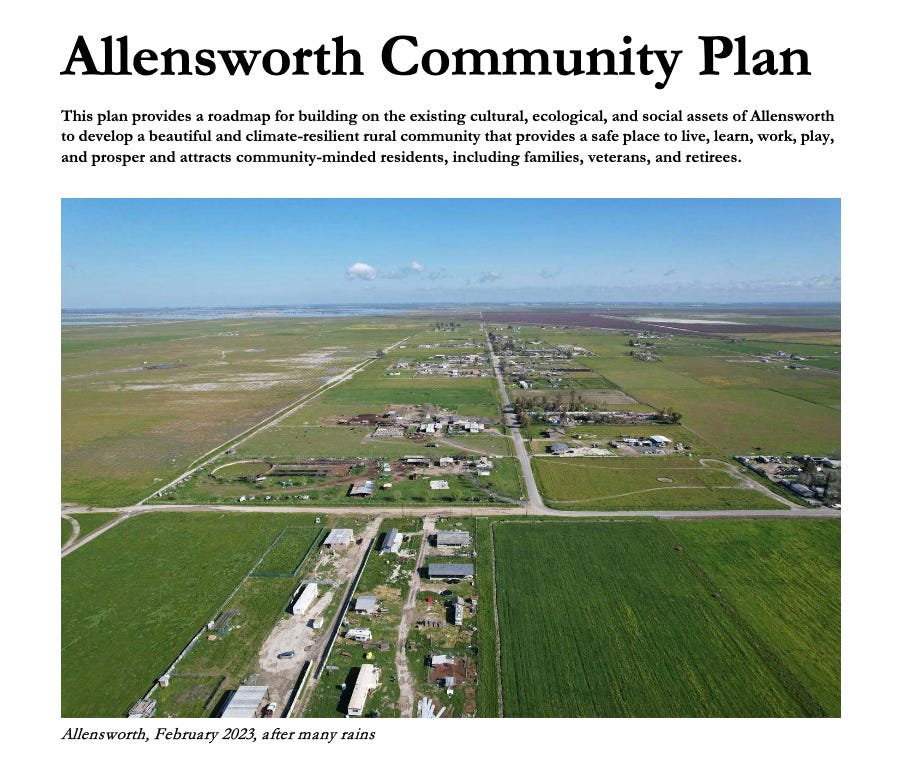
And yet. Just last month, over a century later, the Allensworth Community Plan was unanimously approved by the Tulare County Board of Supervisors. After six years of community engagement stewarded by the Allensworth Progressive Association, the plan charts a path toward climate-resilient rural self-sufficiency: clean water, energy sovereignty, regenerative agriculture, affordable housing, all rooted in Allensworth’s history as California’s only Black freedom colony. It is, in its own way, a continuation of the project The Sentiment Maker was circulating in 1912: a community narrating itself, against all odds, into a future it intends to build.
What these histories of Black print culture reveal is that sentiment making exceeds the Washingtonian ideology it was born inside. It names something more durable and more capacious: the way print, passed from hand to hand and embedded in the rhythms of everyday life, has long been one of the most powerful tools for changing the political weather of any given moment, shaping what feels like “common sense” and expanding the horizon of what is politically possible.
In 1912, The Sentiment Maker was building the case for Black self-determination and westward migration. Today, Allensworth residents are making sentiment for their future, advocating for a community disproportionately burdened by industrial agriculture, farmworkers whose labor generates billions in Central Valley wealth while living without clean water, food security, or economic opportunity. The ends have shifted across generations. The technology of sentiment making has persisted.
These gestures of self-representation from 1912 become precious not only because they are rare, but because they are deliberate. They committed these words to paper for a reason, and now we are left to ask how they might be cited, taken up, and put to work in the continuum of liberation that connects their moment to ours.5
Arianne Edmonds, We Now Belong to Ourselves: J.L. Edmonds, The Black Press, and Black Citizenship in America (2024), p. 104. Edmonds is the great-great-granddaughter of Jefferson Lewis Edmonds, founder of The Liberator. The personal connection doesn’t escape me: her ancestor’s paper and my great-uncle’s colony were part of the same Black Western world. Generations later, we’ve connected through her important work with Black History in State Parks, a collaboration between the California African American Museum and the California Department of Parks and Recreation.
Ed Goodwin Sr. quoted in Victor Luckerson, Built from the Fire: The Epic Story of Tulsa’s Greenwood District (2023), x. Luckerson opens the book with an account of The Eagle and the Goodwin family that has stewarded it for generations.
This logic of economic self-sufficiency as a pathway to advancement is very much alive in contemporary debates about Black capitalism. I really enjoyed this recent Bad Faith episode, The Black Capitalism Trap, which unpacks the viral moment when Marc Lamont Hill defended socialism against a panel of co-hosts who point to billionaire Black entrepreneurs like Jay-Z as evidence of progress.
I've written more about Allensworth's water history in a previous dispatch, Water Finds a Way.
“Preservation through use” is a term I learned from Interference Archive, a volunteer-run library, gallery, and archive of historical materials related to social and political movements here in NYC. They use it to describe their open-stacks collection, in which anyone can browse, handle, and explore materials without restriction (see Alycia Sellie, Jesse Goldstein, Molly Fair, and Jennifer Hoyer, “Interference Archive: A Free Space for Social Movement Culture” (2015), 9). This approach stands in contrast to more traditional archival models that emphasize restricted access and careful handling. Rather than treating preservation as protection from use, it understands use itself as the condition of preservation, supporting the ongoing life of social movement culture. See also A. K. Thompson, Citation and the Archive, on the relationship between citation, social movements, and the political role of archivists.