
From → To
Four frameworks for moving through transformative change

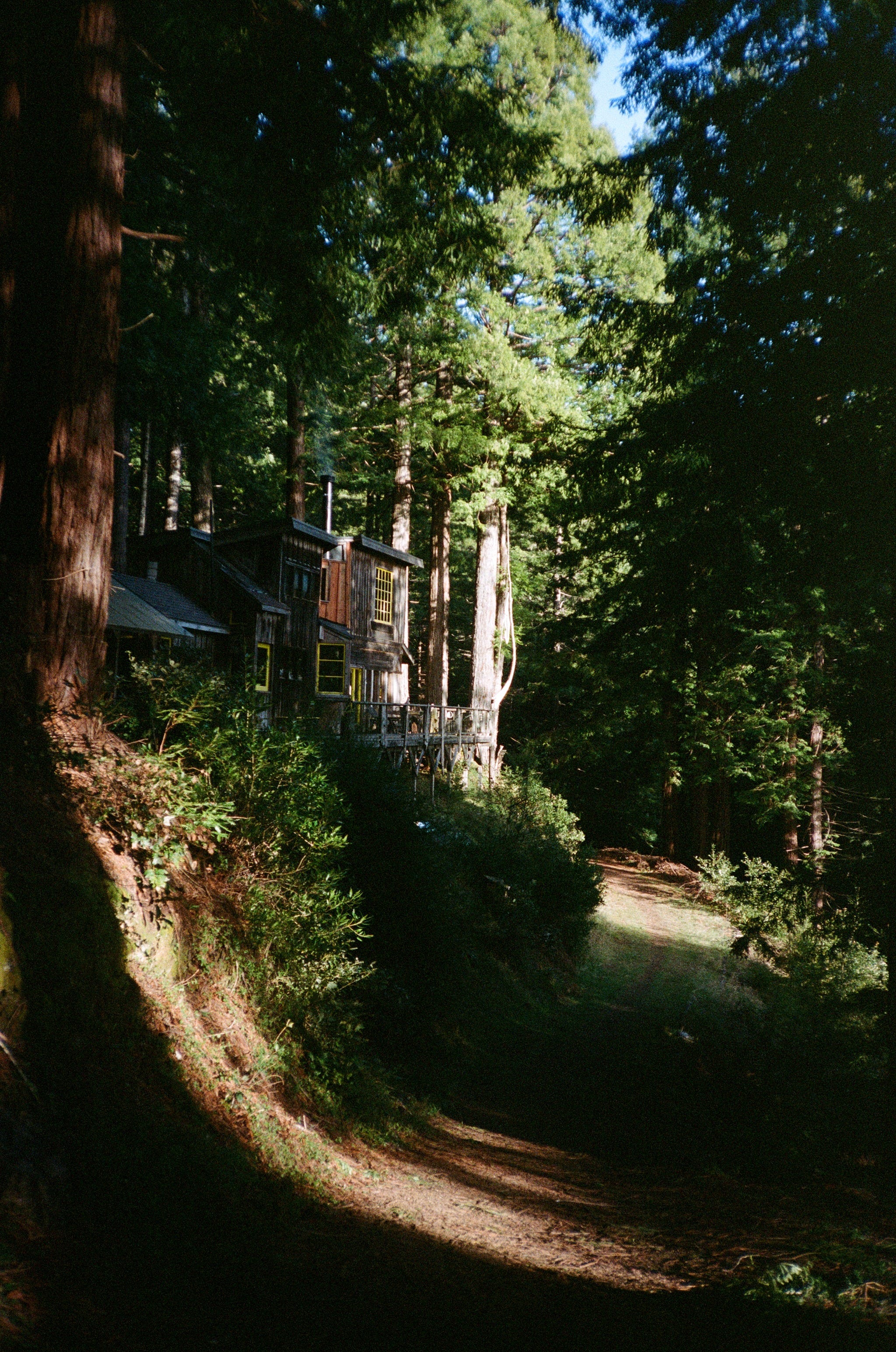
Earlier this year, I resigned from my nine-to-five job and stepped into the big, uncertain world of self-employment.
I submitted my notice and headed to my hometown for some previously planned PTO: a land project skill-share at Salmon Creek Farm on the Northern California coast. It was the softest place I could imagine landing after such a decision. The farm holds a long lineage of back-to-the-land seekers, people trying to unlearn one grammar of living while rehearsing another.
Leaving a job I worked hard for carries a strange kind of disorientation. As Selah Saterstrom once put it, “To walk away is to rupture the narrative that taught you how to be seen—and in doing so, how to see.”
Some part of me kept asking: Who would I have become if I stayed?
Those questions didn’t disappear once the decision was made. If anything, they became louder once the line had been drawn in the sand.
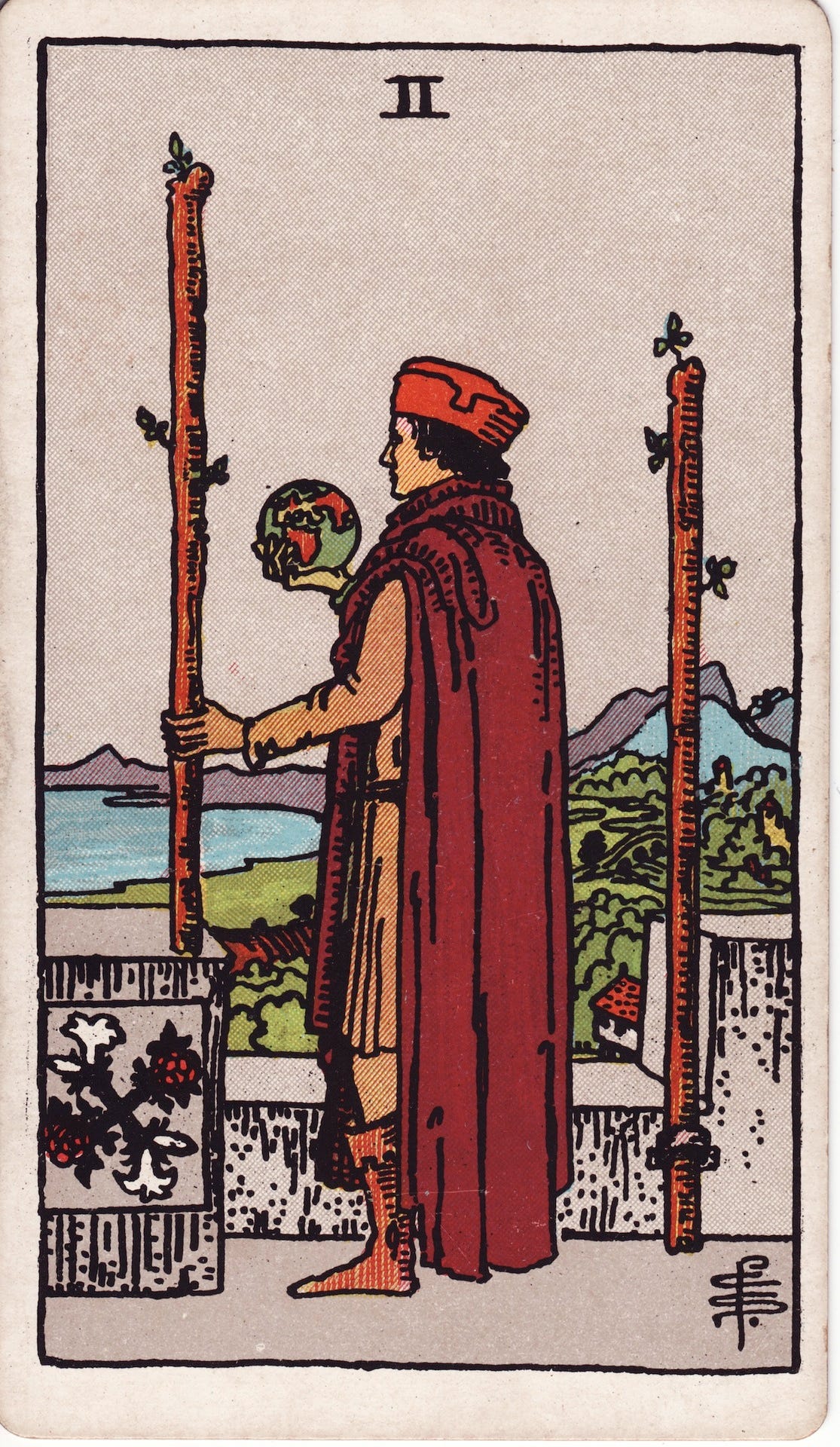
Right before heading to California, I pulled the Two of Wands from my tarot deck. In Pamela Coleman Smith’s illustration a well-dressed figure stands on a tower holding a globe, looking toward a horizon. One wand rests in his hand while another is fixed to the wall behind him, suggesting that although he is contemplating what lies beyond the castle, he has not yet left its safety. The card is often understood to be about the possibility that exists beyond the familiar.
Jessica Dore writes about this card through the philosopher L.A. Paul’s idea of transformative experience. Some choices, Paul argues, are impossible to evaluate in advance because the experience itself changes who you are. Before it happens, you can’t know what it will feel like from the inside. You can imagine it, project yourself into different futures, weigh pros and cons—but the truth is you only learn what the choice means after you’ve already made it.
Over the past few months I've been turning the frameworks I've accumulated across my career in social work, arts organizing, and design strategy back on myself. These are tools I reach for with clients (in consulting rooms, facilitation spaces, therapeutically informed work) to help people navigate moments of change.
This dispatch is an attempt to make sense of the transformative experience I’ve stepped into using the same frameworks I’d offer someone else.
What I’ve found is that each framework, in its own way, pushes against the desire for certainty. And certainty, I’ve come to believe, is exactly what transformative decisions ask you to give up. Clarity tends to emerge through movement.
If you’d prefer to skip around, the essay loosely moves through four of them:
Reauthoring — thickening the stories we tell about our lives
Futuring — exploring possible futures and directional change
Vent Diagrams — holding two contradictory truths without resolving the tension between them
Colored People Time — alternative relationships to time beyond linear progress
If any of this resonates, or if you’ve experimented with similar practices, I’d love to hear about it ❤️
1. Thickening the stories we tell about our lives
Narrative therapy starts from the idea that identity is not fixed but storied: we understand ourselves through the narratives we tell about our lives. According to narrative theory, the stories we inherit don’t simply describe reality, they organize what feels possible. Narrative therapy works with this insight by paying close attention to these stories, examining how they formed and whether they still serve us.
One concept that emerges in this work is the distinction between “thin” and “thick” stories. Thin stories flatten complexity. They rely on limited evidence and reduce a person to a single interpretation of events. Because these narratives are reinforced—by ourselves, by institutions, by culture—they can begin to feel like the only story available.
Thick stories, by contrast, gather more of the record. They collect moments, relationships, values, contradictions, and overlooked details that complicate the thin narrative. The work isn’t to erase the thin story but to thicken an alternative one, assembling enough evidence that a different account of the self becomes visible and believable. This process is often part of what practitioners call “reauthoring” a life story.
In the months leading up to the decision, there was a quiet voice that kept getting louder: even though I had worked really hard for my job, something felt off. Eventually I couldn’t keep ignoring it.
Like many transformative decisions, leaving my job didn’t make perfect sense on paper. The thin story that was informing my self-doubt about acting on the discomfort I was experiencing was shaped by the cultural expectations we’re taught to measure ourselves against: stability, prestige, upward career trajectories.
Making the decision wasn’t a promise of ease. It also required grieving the version of myself who would have stayed, and the thin story had a role in that grief. Over the weeks that followed, it became important to gather evidence of everything I was saying yes to in order to counterbalance the louder story about what I was losing. In narrative terms, I wasn’t trying to disprove the thin story so much as thicken an alternative one—one that affirmed the decision was aligned with the person I was becoming.
It’s part of what made Salmon Creek Farm feel like such a soft landing. The farm itself was founded by people rejecting dominant modes of consumption and conventional definitions of what a successful life should look like. Learning about the original communards and their experiments in collective living made visible how many other stories become available to us when we begin to reauthor the ones we’ve inherited.1
I often feel something similar when I visit Allensworth, a town built by people who stepped onto the land with little more than faith and a blueprint for something different—people who happen to be part of my own family history. Encountering stories like that widens the aperture on what feels possible. When someone builds a life or community outside the constraints of what we’ve been taught is possible, it raises the bar for everyone else’s imagination. It helped me thicken my story by expanding what feels thinkable, livable, even winnable.
The next framework offers another way of bringing that sense of possibility within reach.
2. Exploring possible futures and directional change
In design and strategy work, futuring (or futures thinking) refers to structured foresight methods that help groups of people think beyond the immediate constraints of the present. The goal isn’t to predict what will happen with certainty. It’s to explore what could happen and use that exploration to make more thoughtful decisions today.
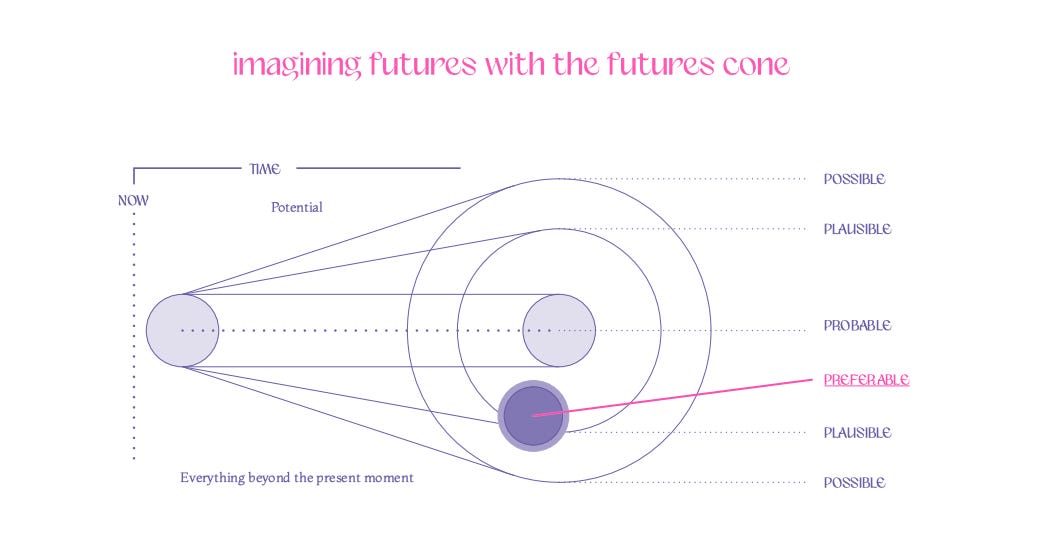
Activities like futures cones, speculative prompts, and artifacts-from-the-future stretch the imagination just past the planning horizon.2 They help people explore different ways the future might unfold in order to ask what actions in the present might move us toward the futures we want.
Often the insights that emerge from futuring get translated into simple directional frameworks that provide a visual analog for change:
From → To
Current State → Future State
Insight → Opportunity
Dominant Frame → Alternative Frame
Problem → Possibility
Tension → Design Principle
Signal → Implication
At their best, these mental models aren’t about prediction so much as preparation. They are directional rather than destinational: tools for naming what we’re moving away from, what we hope to move toward, and the commitments or experiments that shift might require.3
These kinds of directional frameworks are everywhere once you start looking for them. Here are a handful from my own toolkit, plus one I stumbled across in the wild:


I started by sketching out a few possible futures. One path looked like continuing in DEI and organizational design—a life organized around institutional influence, leadership, working change from inside existing structures. Another looked like leaning further into social practice art and land-based cultural work, which comes with a different set of values about what work is for and what a life built around it might look like. There were also hybrid futures: consulting part-time, jumping back into independent curating, hustling grants, building my creative practice, and on and on.
Mapping out these possibilities made it easier to see the possible future selves each path might produce. It also created an opportunity to notice patterns across them: how each future generated value, where the contradictions lived, and which directions carried the strongest gravitational pull.
What they couldn't do, though, was help me hold more than one in tension. Which is where the next framework became necessary.
3. Holding two truths without resolving the tension between them
Transformative decisions aren’t just about moving from here to there, from worse to better. They require capacity to stay with uncertainty.
One tool that engages with this tension is the vent diagram, a framework started by educator E.M./Elana Eisen-Markowitz and artist Rachel Schragis. Unlike a Venn diagram, which maps overlap between categories, a vent diagram maps the overlap between two statements that appear both true and contradictory, leaving the center intentionally unlabeled. The diagram doesn't resolve the contradiction. It asks you to act from inside it, which turns out to be a completely different kind of decision-making.
Here are a few vents I made while deciding whether to stay or go:
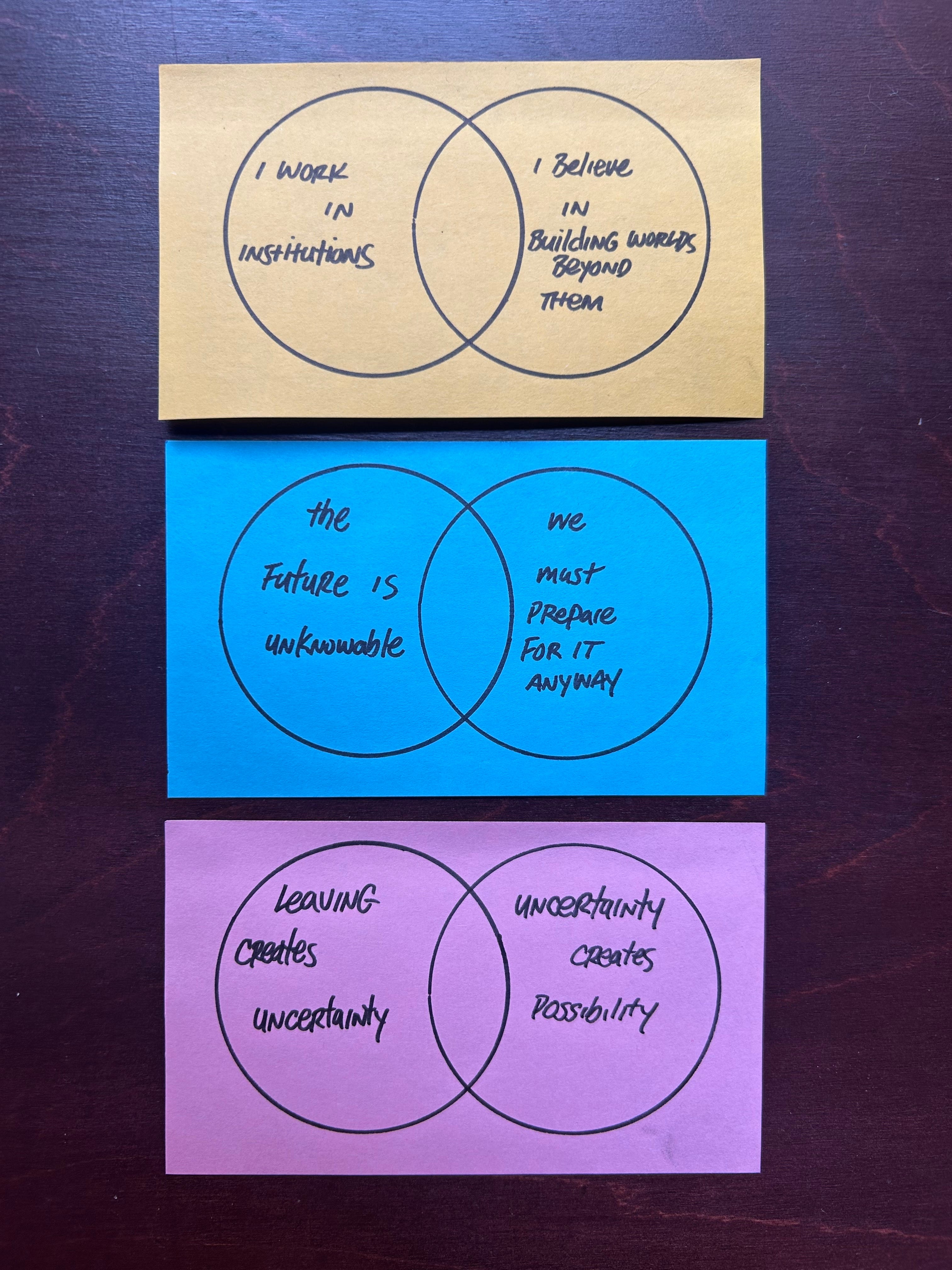
Even on the other side of the decision, both sides of each diagram remain true for me. The question that emerged from the overlap wasn’t which one outweighed the other, it was how to move from their messy intersection in a way that aligns my labor with the life and world I’m trying to cultivate.
My friend Tracee Worley describes futures as compost, and I think this is exactly right: decay and emergence occurring together, neither cancelable by the other. She puts it this way:
“When I hear the kind of futures coming out of Silicon Valley, I don’t want that kind of continuity. I don’t want to live in that future. Futures, to me, feel more like compost. It’s a messy, relational process. I think good futures should involve decay and death and humility, especially given all that we are facing right now. I think futures require us to let go of control and be more accountable to histories that we can’t undo.”
Seen this way, moving toward a preferred future doesn't mean abandoning one side of the diagram for the other. The tension remains. The future grows from the past it cannot discard.
4. Alternative ways of relating to time
Each of these frameworks implicitly asks something about time. When do we break from the past? How far ahead can we see? What do we owe what came before?
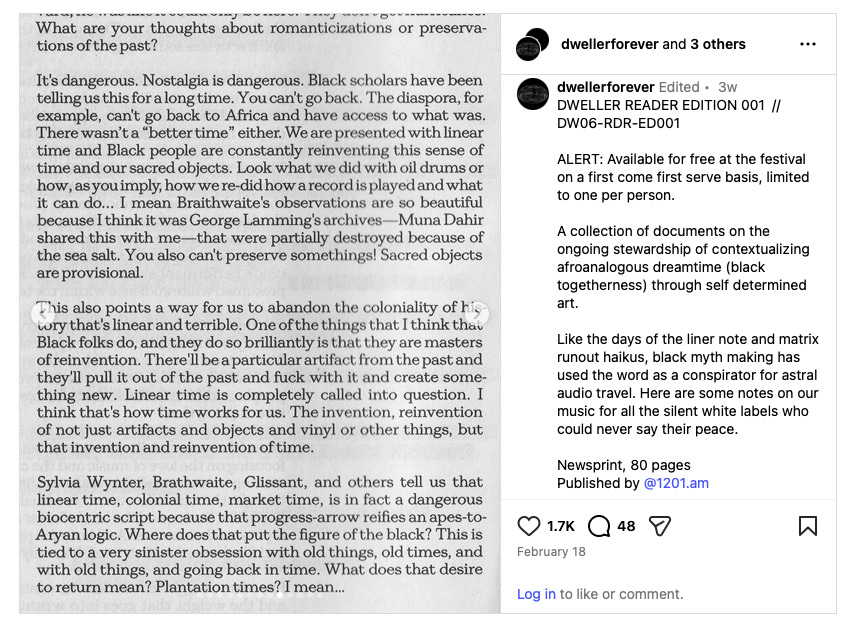
Western modernity tends to organize time as linear progress: a movement from past to present to future, each stage superseding the last. Black thinkers such as Katherine McKittrick and Sylvia Wynter have challenged this “progress arrow,” pointing out how it often reifies imperialistic logics of development and hierarchy. In contrast, many Black cultural practices imagine time differently—not as a straight line but as something recursive, layered, and alive in the present. Echoing Tracee’s description of futures as compost, rather than abandoning the past in pursuit of a new beginning, the past becomes material: something to pull forward, recombine, and reinvent.4
Most people encounter Colored People Time as a joke about lateness. Curator Meg Onli reclaims it as a challenge to the idea that being “on time” is the only way of being “in time.” Time, in this framing, is not a schedule imposed from the outside but something you produce from within. As Onli writes, "the creation of blackness itself has always been a means of producing a time that has yet to arrive."
Rasheedah Phillips traces this further, showing that temporal oppression and spatial oppression have always been entangled: from plantation time management through sundown towns to eviction records that trap people in a permanent past. To control someone's time, she argues, is to control their access to the future.
Katherine McKittrick says it better than I can in this conversation with Ryan C. Clarke for Dweller:
I learned a great deal during my first corporate job. In many ways it was a meaningful career experiment—one that revealed both the possibilities and limits of design as a tool inside market capitalism.5 The skills and sensibilities I developed there will keep showing up, just in service of different questions.
Thinking about time this way helped me understand the decision to leave my job differently. If time is a practice of recombination rather than a linear sequence of right and wrong turns, the question changes. The decision stopped feeling like a break in the trajectory of my career and more like a rearrangement of the materials that have always been there. Now that I’m outside the cadence of corporate time, time feels more ambient. Something I can move within rather than keep up with.
What these four practices share—and what I’ve come to think is their deepest wisdom—is that the future isn’t something that simply happens to you. It’s something you produce. Each has been a helpful companion in unlearning the modern assumption that the future is pre-written.
Strategy might help us prepare for the future, but even the best frameworks eventually arrive at the edge of what can be known. At that edge, we still have to act.
I still don’t know exactly what comes next. But I know that what might have been never really stops mattering.6 It stays present as material I’ll continue working with— compost for whatever comes next.
✨ IMAGE SOURCES FROM SECTION 2 ✨
Top Row: Tema Okun’s White Supremacy Culture characteristics + antidotes, as presented in Dr. Elizabeth “Dori” Tunstall’s lecture Antiracist Design; power-building formulas via the Practical Radicals Workbook; continuum of community-informed to community-led design practices.
Middle Row: Continuum of Becoming an Anti-Racist Multicultural Organization; Deloitte DEI Maturity Model; chart from Restoring the Kinship Worldview.
Bottom Row: the Chinatown bus depot in my hood; Relational Citation System by Deborah Khodanovich.
My coach Melissa Wong has a wonderful podcast episode called “The Under-Examined Superpower of Coherent Visioning,” where she talks about coherence as a way of integrating the different stories we hold about our lives into a guiding narrative for what comes next.
Some inspiring artifacts-from/to-the-future: Seneca Falls 2048 by Radical Futures Studio; the Iyapo Repository by Salome Asega and Ayodamola Okunseinde; Dial-an-Ancestor by Tamika Abaka-Wood.
Vanessa Machado de Oliveira's chapter “Warm-up: Into the Future” in Hospicing Modernity (2021) offers a beautiful model for opening up exactly this kind of conversation with groups. In her case, within the context of climate collapse and the limits of Western modernity.
Saidiya Hartman’s concept of the subjunctive is helpful here. She approaches the past not as something closed, but as a field of unrealized possibilities that continue to shape the present. See “Venus in Two Acts” (2008).
I just picked up Maggie Gram’s The Invention of Design: A 20th Century History (2025) from the library and it has a really sharp account of design’s relationship to the capitalist project, especially Chapters 4 and 6 on the origins of human-centered design and design thinking.
Inspired by Jean Chen Ho’s gorgeous 2022 essay “The Subjunctive.” I’m not linking it here in solidarity with the New York Times boycott.
Love the way you shared the personal inroad to the framework and how they link to one another. Putting these in my pocket! :)